
02 / Petroleum terminals
Understand the transfer.
Explain the difference.
Operating history, comparisons and service context for shore-side equipment.
Connect suitable measurements through an onsite gateway. Give operators and technicians local and remote views of the transfer, the equipment and the events around a change.
Discuss your terminalDefine the boundary first
A shared transfer.
Clear responsibility.
For tanker-ship unloading, vessel and shore equipment can have different owners, measurements and control responsibilities. A useful assessment begins by agreeing exactly what is in scope.
- Shore-side equipment
- Identify the applicable pumps, motors, bearings, lubricators and transfer path.
- Available measurements
- Review suitable runtime, flow, pressure, energy and condition information within that boundary.
- Maintenance ownership
- Connect each exception with the team authorized to inspect, refill, repair and verify the work.
Illustrative dashboard
Put a transfer
in context.
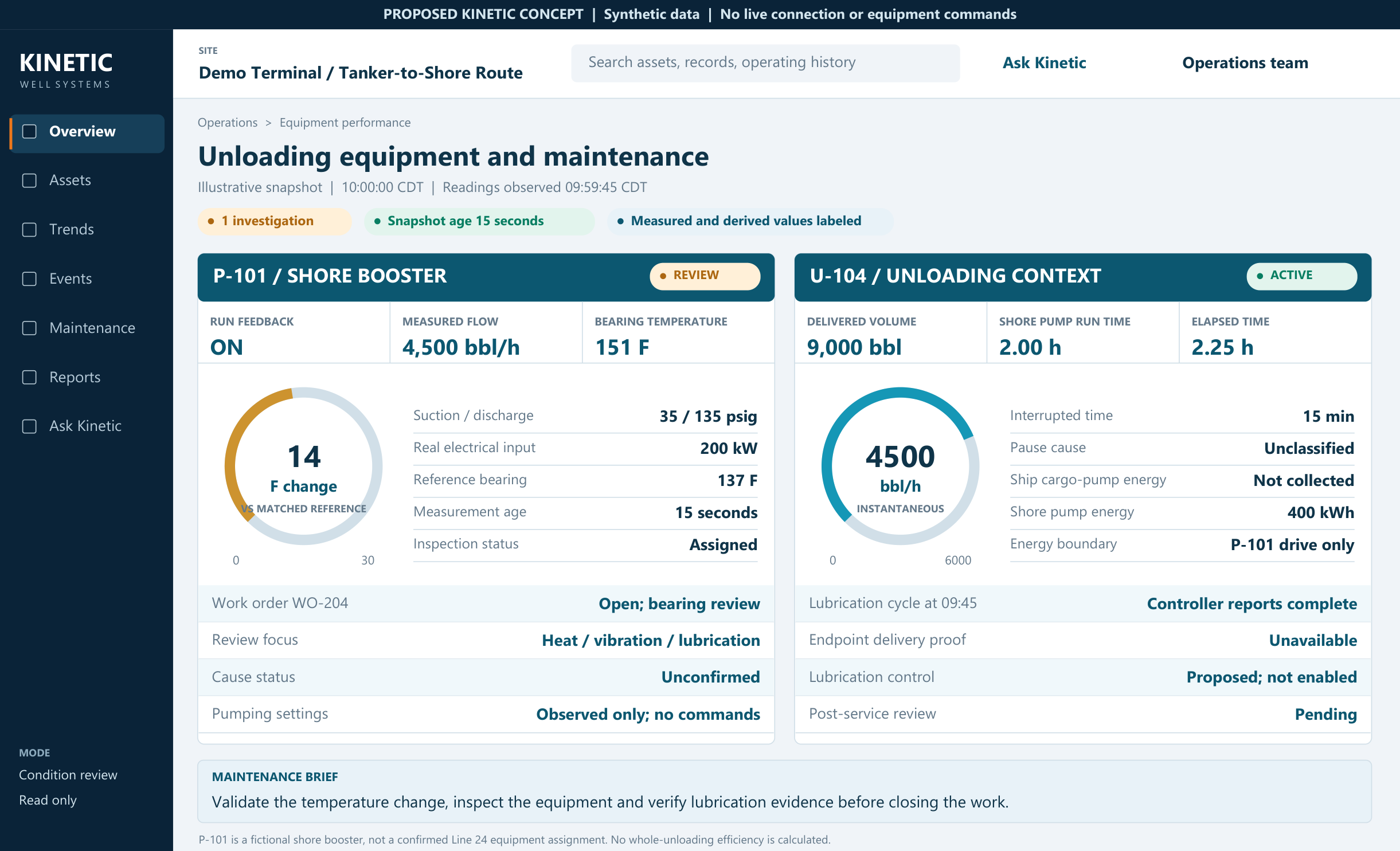
An example of how transfer information and equipment condition could support investigation. It represents a concept, not a connected terminal.
Normal operations deserve a clear report
Two similar transfers.
Different elapsed time.
Compare the product, route and receiving conditions before deciding what a difference means.
Where measurements support it, a configured report can separate elapsed time from running time, show interruption duration and cause, and compare running throughput or energy for the metered equipment. Keep equipment trips separate from planned pauses, receiving constraints and ship/shore coordination delays. A longer transfer is a question to investigate, not automatic evidence of a failed pump.
For a service visit, bring the earlier trend, equipment records and previous finding into view, then review what changed afterward.
A useful maintenance record
See the exception.
Follow the response.
- Place supported lubrication faults beside the operating history.
- Keep an unresolved issue visible across a shift handoff.
- Record the inspection, refill or repair and who completed it.
- Compare before-and-after condition under comparable duty.
Available feedback determines what can be verified. Missing data remains a gap to investigate.
Potential performance evaluation
Understand interruptions.
Then evaluate improvement.
Transfer history may reveal questions worth testing about interruptions or energy per barrel.
A separate evaluation first establishes pump curves, operating limits, measurement boundaries and control authority. Any trial requires site-engineer approval. Shore-side measurements do not describe the entire ship-to-shore system.
No throughput increase, energy saving or automatic transfer-pump control is promised.
A practical first step
Define one shore-side scope.
Bring the equipment list, operating responsibility and a maintenance question from a recent transfer.