01 / Well systems
Know the equipment.
Understand the change.
Equipment monitoring and service history for the people responsible for the well.
Connect suitable controller readings and surface-equipment feedback through an onsite gateway. Use local and remote software to review operating duty, condition and service events together.
Discuss your well equipmentStart with what is installed
Make the existing
signals more useful.
For rod and sucker-rod pumping, review the controller, drive and surface equipment: motors, gearboxes, bearings, belts and suitable lubricators. Hydraulic units need their own equipment profile and limits.
Connections depend on access, compatibility and site approval. Each integration is scoped and demonstrated.
- Operating duty
- Available runtime, stroke rate, accumulated strokes and controller context help explain how the equipment has been used.
- Condition & lubrication
- Suitable temperature, vibration or ultrasound measurements, plus supported reservoir and cycle feedback, help focus an inspection.
- Service history & reports
- Keep findings, parts, repairs and relevant operating events together. Compare before and after the visit under comparable conditions.
A practical operating question
What changed after
the service visit?
An invoice records the work. Equipment history helps show what happened afterward.
Review a trend alongside the previous repair, operating duty and the technician’s finding. A configured report can bring that history together for the next service decision.
The technician assistant can help explain the change and retrieve relevant approved checks from the available records. People remain responsible for diagnosis and the work.
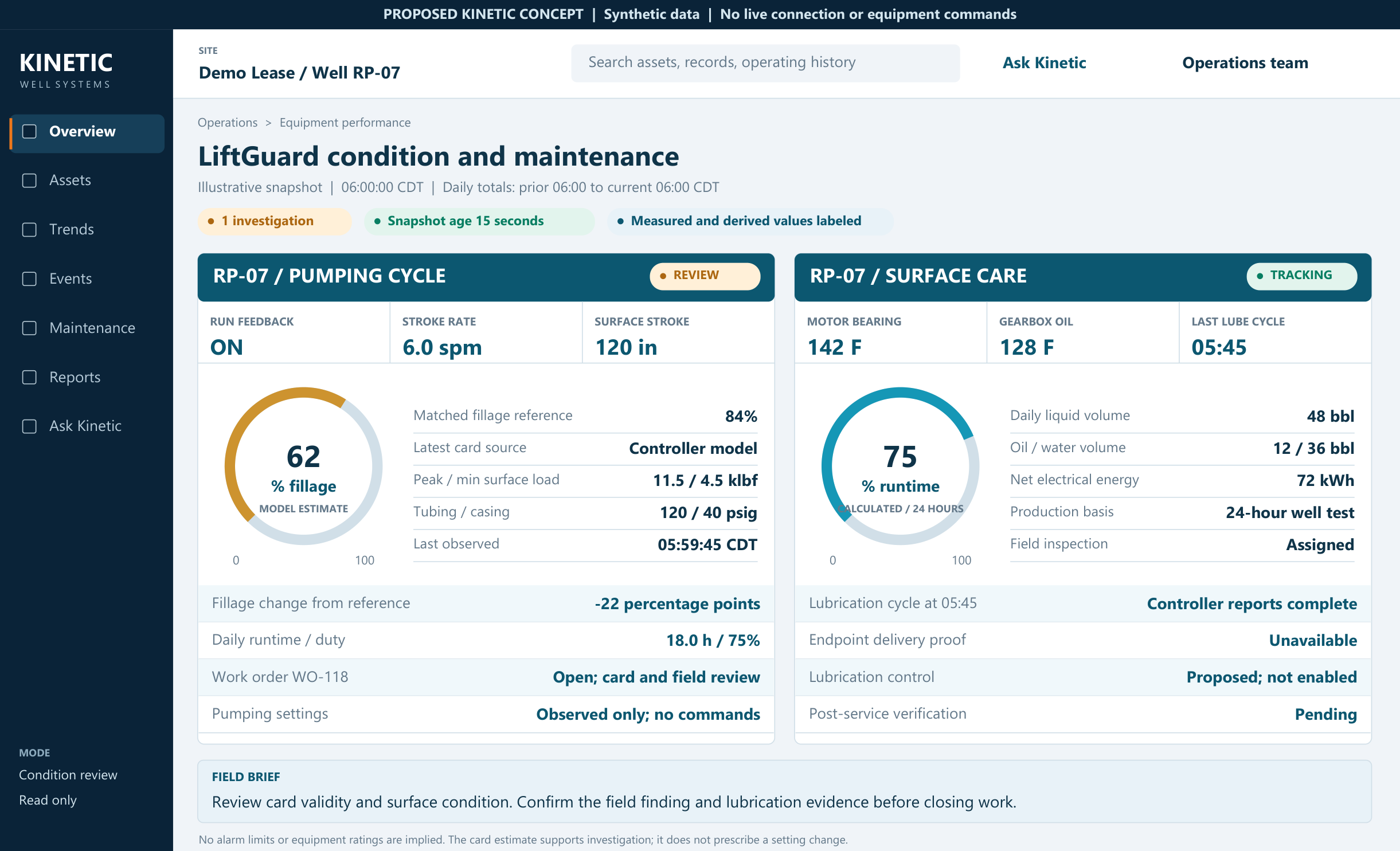
How technician assistance fitsIllustrative dashboard
One view.
More context.
A concept for bringing operating measures, investigation notes and maintenance follow-up together. The values below are synthetic.
What a first scope can cover
A maintenance question
you can actually test.
- Which lubrication tasks or faults are difficult to verify?
- Which signals are available, reliable and time-aligned?
- Who investigates the exception and records the work?
- What evidence would show that the maintenance helped?
A speed change can reflect normal operation. It is not automatically a fault or proof that maintenance is needed.
Equipment-specific scope
Match the evidence
to the machine.
These are assessment options, not a claim that every signal or integration is already installed.
| Equipment profile | Evidence to assess | A useful distinction |
|---|---|---|
| Beam & long-stroke rod lift | Synchronized load/position, controller cards, rod/pump configuration, runtime and work history. | A surface stroke is not the same as the downhole pump stroke. |
| Hydraulic surface rod lift | Actual position, measured rod load or a validated model, hydraulic pressures, oil and filter condition. | Hydraulic pressure alone is not measured rod load. |
| Surface drive & lubrication | Suitable vibration, ultrasound, temperature and drive information, with motor, gearbox, belt and lubrication-point records. | A reported lubrication cycle is distinct from delivery evidence. |
Controller-model estimates depend on configuration. Rotary equipment such as rod-driven progressing-cavity pumps requires its own profile. Sampling must suit the question: slow trends cannot replace within-stroke load/position samples or diagnostic vibration capture.
Potential optimization
Look for an opportunity.
Keep the test honest.
A separate assessment can evaluate whether operating changes could improve sustained results. Existing controls may already adjust speed or pump filling; their behavior is part of the baseline.
Establish the baseline
Review production or well-test data, controller behavior, available load and position information, and equipment limits.
Agree a bounded trial
The site’s engineer approves any setting change. Production controls stay under the operator’s authority.
Compare the full result
Distinguish sustained oil production from total liquid or temporary drawdown. Include water handling, energy and equipment condition.
No production gain, savings percentage or autonomous optimization is promised. Core maintenance work leaves production-pump settings unchanged.
A practical first step
Start with one equipment group.
Bring the lubricator and controller models, the available feedback, and a recent maintenance issue.